US vs UK vs Metric Cups: Why a Cup Isn't Always the Same Size
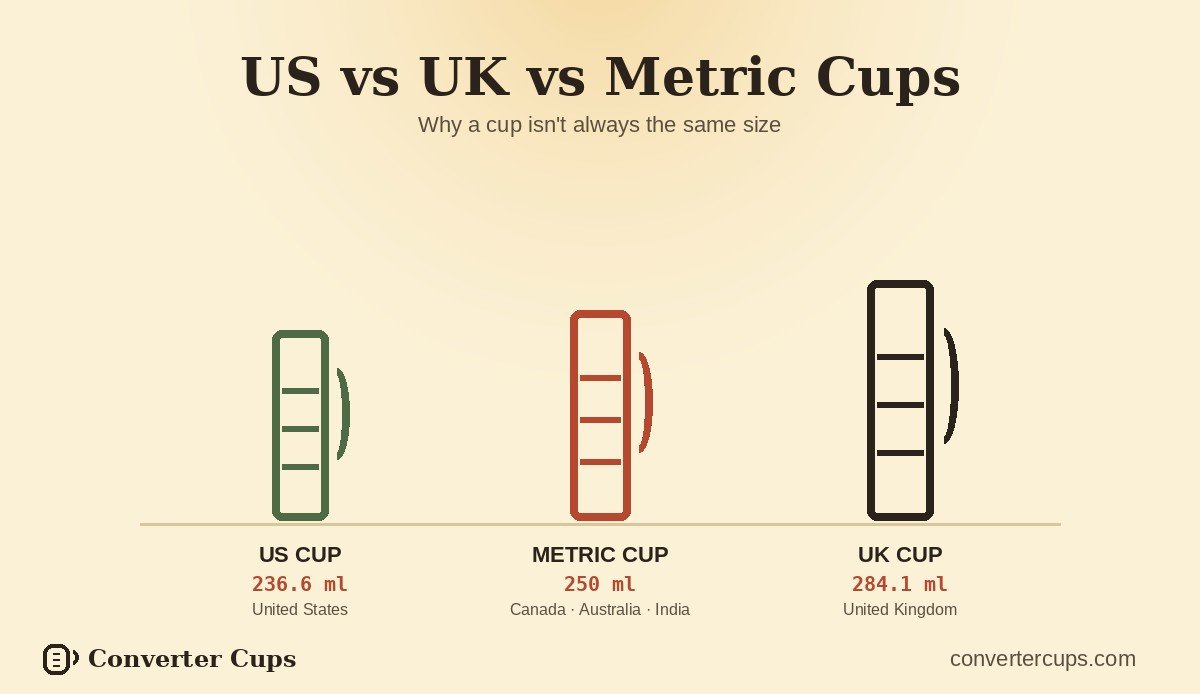
If you've ever followed a recipe from a website in a different country and had it turn out wrong for no obvious reason, there's a decent chance the "cup" is to blame. It sounds like it shouldn't be possible — a cup is a cup, right? Not quite. A US cup, a UK cup and a metric cup are three genuinely different volumes, and getting the cup conversion wrong is one of the most common reasons home bakes don't turn out the way they should.
This is one of the most overlooked baking measurements problems out there, and it's worth understanding properly before your next international recipe attempt.
What Is a US Cup?
In the United States, a cup used in cooking is standardized at 236.6 millilitres (236.588 ml, to be exact). This is the cup size baked into every American measuring cup set, and it's what nearly every US recipe site assumes when it says "1 cup of flour" or "2 cups of milk." There's also a slightly different figure called the US "legal" cup — 240 ml — which shows up on nutrition labels rather than in recipes. For everyday baking, though, the 236.6 ml US cup is the one that matters.
What Is a UK Cup?
A UK cup, sometimes called the Imperial cup, is 284.1 millilitres — about 20% bigger than a US cup. In practice, though, most modern UK recipes have moved away from cup measurements altogether and use grams and millilitres instead, which is actually one of the reasons British baking tends to be more consistent than American baking. Still, if you come across an older UK recipe or a conversion chart that references a "UK cup," 284.1 ml is the figure it means.
What Is a Metric Cup?
This is the one that trips people up the most in baking measurements, because it doesn't map neatly to either of the above. A metric cup is 250 millilitres, and it's the standard used in Australia, New Zealand, Canada and India. It's bigger than a US cup but smaller than a UK cup — close enough to both that it's easy to assume it's "basically the same," which is exactly the assumption that causes problems.
Why Does This Difference Exist?
None of these cup sizes were designed by scientists sitting down to agree on a global standard. Each one grew out of a country's broader measurement system — the US never fully adopted metric, the UK partially did, and countries like Australia and Canada standardized on metric cup sizes when they made the switch. A "cup" was always a kitchen convenience unit rather than a precise scientific one, so when different countries metricated (or didn't) at different times, their cup sizes simply froze wherever that country happened to be at the time.
How Big a Difference Does It Actually Make?
Bigger than most people expect. Take flour: one US cup of flour weighs roughly 125 grams. Because a UK cup holds more volume, the equivalent UK cup of flour weighs closer to 150 grams — and a metric cup lands around 132 grams. That's a 25-gram swing on a single cup of flour, purely from cup size, before you even factor in how tightly the flour is packed. In a cake recipe with 2–3 cups of flour, that difference is large enough to noticeably change the texture of what comes out of your oven.
How to Tell Which Cup a Recipe Means
Since most recipes don't spell out which cup they're using, doing the right cup conversion usually means inferring it first. A recipe from a US food blog almost always means a US cup. A recipe that lists both cups and grams side by side — common on Australian and UK baking sites — is a strong hint it's using a metric cup. When in real doubt, the safest assumption for anything written in metric units elsewhere in the recipe is the 250 ml metric cup, since that's the standard nearly everywhere outside the US.
The Easiest Fix: Weigh When You Can
The most reliable way around all of this cup confusion is to sidestep cups entirely and weigh ingredients in grams instead. A kitchen scale removes the guesswork about cup size, and it also removes the second variable that trips people up — how densely an ingredient is packed into the cup. If a recipe gives both cup and gram measurements, use the grams. If it only gives cups, that's where knowing the source country's likely cup size becomes genuinely useful — our cups to grams converter handles all three cup standards automatically.
Quick Reference: Cup Sizes by Country
Keep this cup conversion table handy for baking measurements whenever a recipe doesn't specify which standard it's using:
| Cup Type | Volume | Common In |
|---|---|---|
| US cup | 236.6 ml | United States |
| US legal cup | 240 ml | US nutrition labels |
| UK cup (Imperial) | 284.1 ml | Older UK recipes |
| Metric cup | 250 ml | Australia, Canada, India, NZ |
| Japanese cup | 200 ml | Japan |
The Bottom Line
Getting baking measurements right starts with knowing your cup size. A cup conversion mistake is one of the quieter reasons recipes fail, precisely because it doesn't feel like the kind of thing that should matter. But once you know a US cup, a UK cup and a metric cup are three different sizes — not just regional habits, but actual different volumes — a lot of "why didn't this turn out right" moments start to make sense. The fix isn't complicated: know which cup size a recipe is using, or better yet, convert to grams and skip the ambiguity altogether.
Convert any cup size instantly
US, UK and metric cups, plus grams, kilograms and litres — all in one free tool.
Open the converter