Cake Pan Conversion Guide: How to Swap Pan Sizes Without Ruining the Recipe
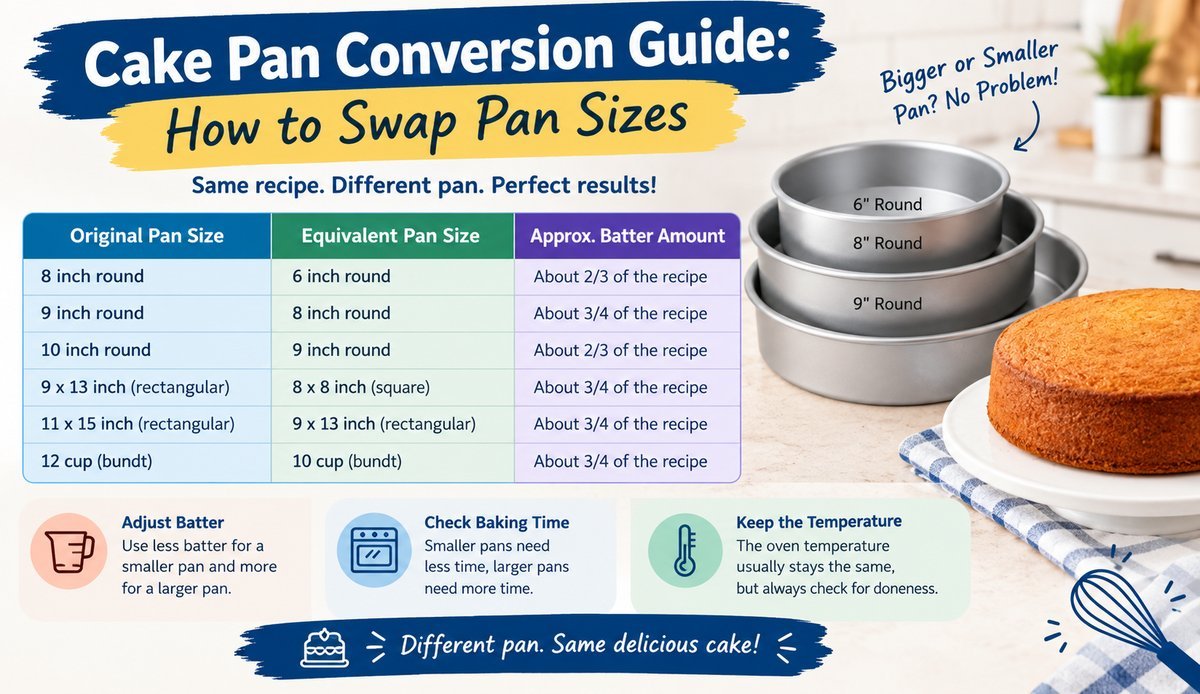
Baking a cake is usually straightforward until you discover that the recipe calls for a pan size you do not have. Maybe a recipe asks for an 8-inch round cake pan, but your kitchen has a 9-inch pan. Or perhaps a European recipe gives measurements in centimeters and grams while your American measuring cups and spoons are ready to use.
This is where cake pan conversion becomes extremely useful.
Understanding how to adjust cake pan sizes, ingredient quantities, temperatures, and measurements can help you bake successful cakes without starting from scratch. For home bakers in the USA, it is also helpful to understand the difference between U.S. customary measurements and metric measurements.
Whether you are converting a cake tin, checking cups to grams, using an oz to cup conversion, or looking for a convenient conversion calculator, the right approach can prevent common baking mistakes.
What Is Cake Pan Conversion?
Cake pan conversion means adjusting a recipe when you want to use a different pan from the one recommended in the original recipe.
The size and shape of a cake pan affect how much batter it can hold. They also affect the depth of the batter, baking time, and sometimes the final texture of the cake.
For example, moving batter from a smaller deep pan into a larger shallow pan may cause the cake to bake faster. Using a smaller pan may make the batter deeper and require a longer baking time.
A good cake pan conversion does not simply mean changing the pan. You may also need to adjust the amount of batter and monitor the cake carefully while it bakes.
A conversion calculator can help with mathematical calculations, but understanding the basic principles gives you more control.
Why Cake Pan Size Matters
Cake recipes are developed with a specific pan capacity in mind. If the wrong pan is used, several things can happen.
A pan that is too large may produce a thin cake that finishes baking quickly. A pan that is too small may become overfilled, causing batter to overflow.
For this reason, cake pan conversion is particularly important when working with layer cakes, cheesecakes, brownies, and other recipes where pan depth matters.
Before making a substitution, compare the surface area and approximate capacity of the original and replacement pans. For round pans, you can use the basic area formula:
Area = π × radius²
You do not always need to perform complicated calculations, however. A reliable conversion calculator or cake pan size chart can make the process easier.
Common U.S. Cake Pan Sizes
American baking recipes commonly use pans measured in inches. Some popular sizes include:
- 6-inch round pan
- 8-inch round pan
- 9-inch round pan
- 10-inch round pan
- 8 × 8-inch square pan
- 9 × 9-inch square pan
- 9 × 13-inch rectangular pan
- Standard 12-cup Bundt pan
- Standard 12-cup muffin pan
When replacing one pan with another, try to choose a pan with a similar capacity.
For example, an 8-inch round pan and a 9-inch round pan are not identical. The 9-inch pan has a larger surface area, so the same amount of batter will be shallower.
This is where cake pan conversion helps you decide whether you should increase the recipe quantity or simply adjust the baking time.
Cake Pan Conversion: Round to Square
Converting between round and square cake pans is one of the most common questions among home bakers.
An 8-inch round pan has an area of approximately 50 square inches, while an 8-inch square pan has an area of 64 square inches. That means an 8-inch square pan can hold considerably more batter at the same depth.
When making this type of cake pan conversion, you should consider both the surface area and the depth of the pan.
If the replacement pan is significantly larger, you may need additional batter. If it is smaller, avoid filling it too close to the top.
A conversion calculator can help estimate differences between pan dimensions, but always use your judgment when determining how much batter to add.
Cake Tin Conversion for Metric Recipes
American bakers increasingly encounter recipes from international websites that use centimeters, milliliters, and grams. This is where cake tin conversion becomes useful.
A recipe may mention a 20 cm round cake tin, while an American baker may have an 8-inch cake pan. Since 20 centimeters equals approximately 7.87 inches, an 8-inch pan is generally a close match.
A metric conversion chart can quickly help you compare centimeters and inches. You can also use a metric conversion tool when working with measurements such as:
- Centimeters to inches
- Celsius to Fahrenheit
- Grams to ounces
- Milliliters to cups
- Kilograms to pounds
A metric conversion tool is especially helpful when following recipes written outside the United States.
Metric Conversion for Oven Temperatures
Pan dimensions are not the only measurement issue. Oven temperatures can also vary between countries.
Many U.S. recipes use Fahrenheit, while recipes from other countries may use Celsius. For example, 180°C is approximately 350°F.
A metric conversion reference can help you avoid setting the wrong oven temperature. Before baking, check whether the recipe uses Celsius or Fahrenheit — using the wrong temperature can dramatically affect the result, even if your cake pan conversion is perfect.
A simple metric conversion chart can be kept in your kitchen for quick reference — or use our own oven temperature converter for instant °F ↔ °C ↔ gas mark conversions.
Cups to Grams: Why Weight Matters
Ingredient measurements can create another challenge when adapting international recipes.
U.S. recipes frequently use cups, tablespoons, and teaspoons, while many professional and international recipes use grams. The problem is that a cup does not always represent the same weight — one cup of flour does not weigh the same as one cup of sugar.
Therefore, cups to grams conversion depends on the ingredient. For example, the weight of one cup of flour differs from the weight of one cup of granulated sugar or butter.
When using cups to grams, always identify the specific ingredient before making the conversion. A good kitchen scale is often more reliable than trying to convert every ingredient manually.
Using cups to grams can be particularly helpful when baking cakes that require precise ratios — our cups to grams converter handles this automatically for 15+ common baking ingredients.
Grams to Cups Conversion for American Bakers
The reverse calculation is also common. A recipe may say 200 grams of flour, but you may prefer to measure with cups. In this situation, you need a grams to cups conversion.
However, grams to cups is not a universal calculation because ingredients have different densities. For example, 200 grams of flour and 200 grams of brown sugar will not necessarily occupy the same volume.
For accurate grams to cups results, select the ingredient first — see our 200 grams to cups chart for a full ingredient-by-ingredient breakdown.
For the most consistent results, professional bakers generally prefer weighing ingredients in grams. Still, grams to cups can be convenient for home bakers who do not have a kitchen scale.
Oz to Cup Conversion for Baking Ingredients
American recipes often use ounces, while some recipes may list liquid or dry ingredients differently.
An oz to cup conversion can help when a recipe gives an ingredient in fluid ounces but your measuring equipment uses cups. However, be careful: fluid ounces measure volume, while ounces can also refer to weight.
An oz to cup conversion for liquids is different from converting ounces by weight into cups. For example, fluid ounces and weight ounces should not automatically be treated as interchangeable.
Before using an oz to cup conversion, determine whether the recipe is referring to weight or volume. A reliable conversion calculator can make the process easier, but you still need to select the correct measurement type.
Using a Metric Conversion Chart
A metric conversion chart is one of the most useful resources for anyone following international baking recipes. A basic chart might include:
| Measurement | Approximate U.S. Equivalent |
|---|---|
| 1 inch | 2.54 cm |
| 1 cm | 0.39 inch |
| 1 ounce | 28.35 grams |
| 1 pound | 453.6 grams |
| 1 liter | 4.23 U.S. cups |
| 1 kilogram | 2.2 pounds |
Remember that ingredient conversions can vary depending on density and measurement method.
Keeping a metric conversion chart near your baking area can save time when adapting recipes. You can also combine a metric conversion chart with a conversion calculator when working with unusual quantities.
Conversion Calculator: A Useful Baking Tool
A conversion calculator can simplify many everyday baking calculations. Instead of manually converting measurements, you can enter the original value and choose the desired unit.
A conversion calculator may be useful for:
- Inches to centimeters
- Celsius to Fahrenheit
- Grams to ounces
- Ounces to cups
- Liters to cups
- Pounds to kilograms
- Ingredient measurements
- Pan dimensions
However, remember that a conversion calculator cannot always account for differences in ingredient density or pan shape. Use it as a helpful tool rather than a replacement for baking judgment.
Currency Converter and Baking Websites
You may wonder why a currency converter appears alongside baking conversion tools. The answer is that modern recipe websites often serve international audiences.
If you purchase specialty baking ingredients, equipment, or recipe books from another country, prices may be listed in euros, pounds, Canadian dollars, or another currency.
An online currency converter can help you understand the approximate cost in U.S. dollars. For example, an American baker purchasing a European cake pan may use a currency converter to compare the listed price with a U.S. retailer.
An online currency converter is also useful when comparing international cooking equipment, baking courses, or subscriptions.
Remember that exchange rates change regularly, so an online currency converter should be used for current estimates rather than relying on an old conversion. A currency converter can also be useful when comparing shipping costs or international ingredient prices.
Online Currency Converter vs. Baking Conversion Tools
An online currency converter is designed for money, while baking tools are designed for measurements. It is important not to confuse the two. For example:
- Currency converter → converts money between currencies.
- Online currency converter → provides convenient currency exchange calculations.
- Metric conversion → converts measurement units.
- Conversion calculator → performs different types of numerical conversions.
- Oz to cup conversion → helps compare volume measurements.
- Cups to grams → converts volume to weight for specific ingredients.
- Grams to cups → converts weight to volume for specific ingredients.
Understanding the purpose of each tool helps you choose the right calculation.
What About a Binary Translator?
A binary translator is not a baking measurement tool, but you may encounter this keyword when searching for general online conversion resources.
A binary translator converts binary numbers into readable text or other numerical formats. It has no practical role in determining cake pan capacity, ingredient weight, or oven temperature.
Similarly, a binary translator should not be confused with a unit converter. If you are researching online tools, a binary translator belongs to the technology and computing category, whereas a baking conversion calculator belongs to measurement and recipe preparation.
A binary translator may be useful for computer-related tasks, but it will not help with cups to grams, grams to cups, or cake pan conversion.
Unit Converter for Everyday Baking
A unit converter can be one of the easiest tools for handling different measurement systems.
A unit converter may allow you to switch between inches, centimeters, ounces, grams, cups, liters, pounds, and other units. For example, you could use a unit converter to check whether a 20 cm cake tin is close to an 8-inch American cake pan.
A unit converter can also help when adjusting ingredient quantities or interpreting an international recipe. When combined with a metric conversion chart, a unit converter makes recipe adaptation much easier.
How to Avoid Ruining Your Cake When Changing Pans?
Changing the pan does not automatically mean the recipe will fail. The key is to monitor the batter depth and baking time. Follow these steps:
- Identify the original pan. Write down the original dimensions, such as 8-inch round or 9 × 13-inch rectangular.
- Measure your replacement pan. Check both the diameter or length and width and, when relevant, the depth.
- Compare capacity. A conversion calculator can help estimate the difference.
- Adjust the batter if necessary. If your replacement pan is much larger, you may need more batter. If it is smaller, do not overfill it.
- Watch the baking time. A shallow cake may bake faster, while a deeper cake may take longer.
- Test before removing the cake. Use a toothpick or cake tester in the center. If it comes out with wet batter, continue baking.
Good cake pan conversion is about more than mathematics. Visual judgment and baking experience also matter.
Final Tips for U.S. Home Bakers
When adapting recipes, keep a few simple principles in mind.
- Always check whether measurements are U.S. customary or metric. A metric conversion mistake can change the entire recipe.
- Use cups to grams or grams to cups carefully because ingredient density varies.
- Understand whether ounces refer to weight or volume before performing an oz to cup conversion.
- Keep a metric conversion chart and a reliable unit converter available when following international recipes.
- Use a conversion calculator for pan dimensions and mathematical adjustments, but always monitor your cake while it bakes.
An online currency converter and currency converter are useful when shopping internationally, while a binary translator is intended for computing tasks rather than baking.
Finally, remember that the goal of cake pan conversion is not mathematical perfection alone. It is to maintain a suitable batter depth and give the cake enough space to rise and bake evenly.
Conclusion
Learning cake pan conversion can make baking much less stressful, especially when you enjoy trying recipes from different countries.
With the right approach, you can confidently swap cake tins, compare U.S. and metric measurements, and adjust recipes without compromising the final result.
Tools such as a unit converter, metric conversion chart, and conversion calculator can simplify measurements. For ingredients, cups to grams, grams to cups, and oz to cup conversion are useful when moving between volume and weight measurements.
For international shopping, a currency converter or online currency converter can help compare prices in U.S. dollars. Meanwhile, a binary translator serves an entirely different purpose and should not be confused with baking conversion tools.
Whether you are an occasional home baker or someone who regularly experiments with international recipes, understanding these conversions can help you make smarter pan substitutions and achieve more consistent results.
The next time a recipe calls for a cake tin you do not own, do not immediately abandon the recipe. Check the dimensions, compare the capacity, adjust the batter when needed, and keep an eye on the baking time. With a little practice, cake pan conversion becomes a simple part of successful baking.
Convert any ingredient instantly
Cups to grams, grams to cups, tablespoons to cups and oven temperatures — all in one free tool.
Open the converter